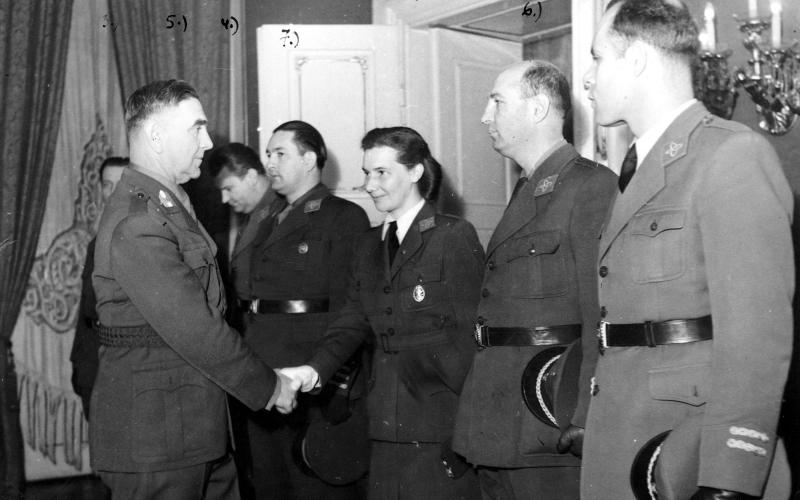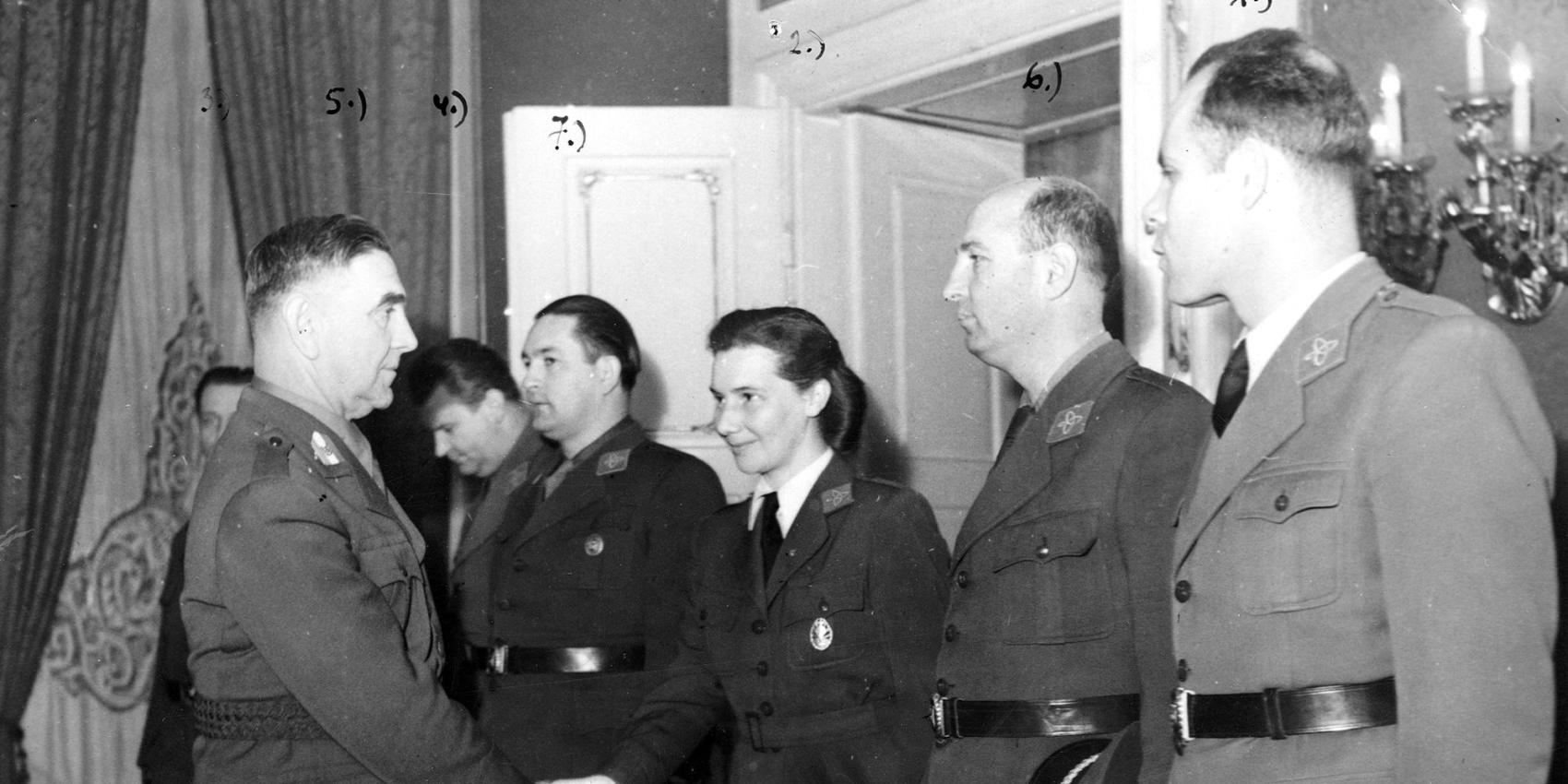
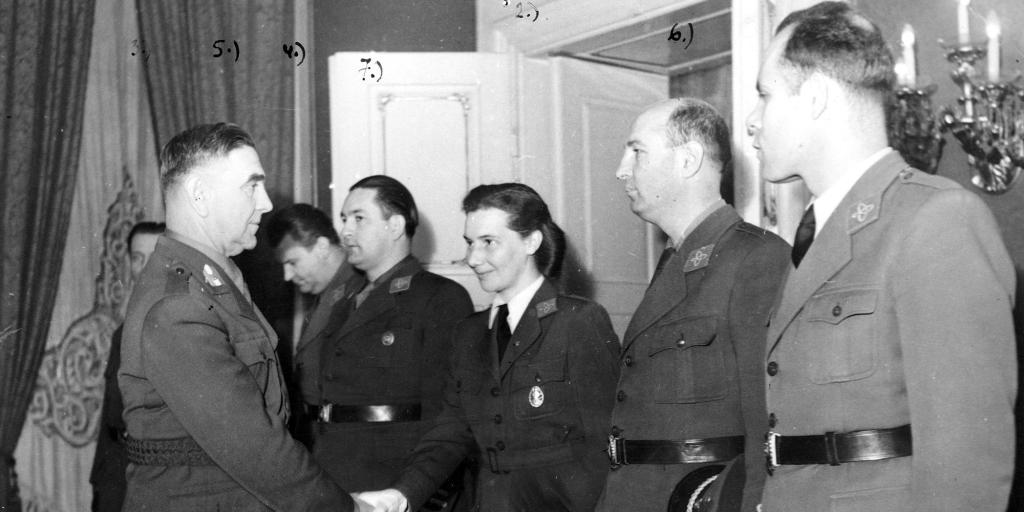
Almost 20 years ago, I had the opportunity to speak with Višnja Pavelić about her father Ante Pavelić, the leader of the Ustaša movement, her politically active mother, Marija, and her own role before and during the founding of the Independent State of Croatia (1941–1945). At the time, I was surprised by how openly the eyewitness and supporter of the criminal movement spoke about women’s involvement in this fascist organization which fought against the Yugoslav state (1918–1941) by any means it could. Višnja Pavelić also recounted how she had been politically educated as a child to support her father during their political exile in Italy. In the Independent State of Croatia, she studied law – like her father – and was being groomed for a prominent role within the Ustaša apparatus.[1] Like her mother, Marija Pavelić, she remained deeply devoted to her father until the end of her life and defended his policies of exclusion and the crimes committed during the four-year existence of the Independent State of Croatia.
The Ustaša movement was among the most radical fascist organizations in Europe. Under the leadership of Ante Pavelić, it established the Independent State of Croatia following the invasion of Yugoslavia in April 1941. The regime was closely allied with Nazi Germany and fascist Italy and pursued a policy of mass crimes and genocide which they perpetrated on Serbs, Jews and Roma.[2] In terms of racial policy, Hitler accepted Pavelić’s statements about the Croatians belonging to the so-called Aryan race, which did not however mean that the Croatian civilian population did not suffer under Nazi terror.[3]
The Ustaše pursued a patriarchal and oppressive policy toward women in their propaganda and, to some extent, in practice. They were especially violent towards women who were unwilling to live according their rules and who did not conform to their political or the fascists’ racial ideology. These included feminists, female partisans and all women who were not defined as Croatian, including Roma, Serbs and Jews. Abortions could be punished by death or long prison sentences in the Independent State of Croatia, a country where sexual violence against women by various troops took place en masse. As a result, midwives who performed abortions on pregnant women, for example, were shot.[4]
For a long time, research on the Ustaša movement concentrated primarily on political relationships, theaters of war and the crimes of the regime. The role of women remained comparatively underexamined. However, women were by no means mere spectators of the political developments in the country. They took on various functions within the Ustaša movement, ranging from propaganda and social work to active participation in the state’s criminal apparatus. The examination of their role provides a better understanding of how the Ustaša regime fits into the research on fascism, collaboration and the Holocaust as well as on the gender-specific politics of oppressive regimes.
Women in the Political Apparatus of the Ustaša Regime
Women had been active in the fascist Ustaša movement since its inception in 1930, taking part in the spreading of propaganda, in its illegal work in political exile and in the Kingdom of Yugoslavia[5], working as spies and even as organizers of the assassination of King Aleksandar I in 1934. In 1941, when the Ustaše came to power with Hitler’s blessing and founded the Independent State of Croatia, the range of women’s activities expanded during the war years. The Ustaša movement sought to ideologize a “Croatian woman and mother” who “releases” herself from the idea of equality and sacrifices for the benefit of the “people’s community” – limiting herself to the patriarchal role of the mother and educator of the “Aryan race.” The so-called “Aryan” woman had to be modest, demure and loyal to her husband. However, this propaganda image of women could not be realized in the war years because the mobilization of women workers in various professions was necessary for the survival of the Independent State of Croatia. In this sense, women worked in a wide variety of sectors: in factories, on farms, in the medical field, as secretaries in various government agencies or in the military. For example, Katarina Matanović-Kulenović was the private pilot of Ustaša ministers. She also flew wounded soldiers through war zones.[6] Of course, she did not fit the Ustaša image of women, but was honored by Pavelić for her “war-related” activity. The authorities justified womenʼs participation in the war as being exceptional occurrences. After the war, the old traditional gender roles were to be restored.
Moreover, women became functionaries in the Ustaša administration and joined forces in the Ustaša movement’s girls’ and women’s associations where they carried out political work. Members of the Ustaša movement, who had actively supported Pavelic’s organization from the beginning, were very rarely confined to the role of mother. As functionaries, they participated in the formation of a new state politically, leading the Female Ustaša Youth[7] and the Women’s Vine of the Croatian Ustaša Movement where they were tasked with spreading propaganda and mobilizing girls and women in the movement. Further, they provided the soldiers with medicine, clothes and food and were responsible for their moral support. Members and leading women in the movement, the leaders of the Female Ustaša Youth, Mira Vrljičak-Dugački and her successor Dolores Bracanović, were united by their strict Catholic faith and the fanatical political struggle to preserve the Ustaša state during the war.[8]
Irena Javor, a former teacher, was one of the leading women in the Independent State of Croatia as head of the female section of the movement, the “Women’s Vine”. She played a particularly important role in the dissemination of fascist propaganda. In a radio lecture, she declared that a woman was a traitor if she did not bear children for the state.[9] Also in her articles, which appeared in various newspapers and magazines like Ustaškinja, the organ of the female section, she exclusively preached a patriarchal role model. However, she herself enjoyed a certain degree of freedom, for example, through her many business trips which she undertook with a male-dominated delegation. In July 1944, Pavelić awarded her the High Order of Merit of the First Degree.[10]
Criminal Women in the Machinery of Extermination
At the same time, women were also involved in various ways in the extermination of human life – of Serbs, Jews, Roma and political opponents. Nor was the support of the criminal system merely the domain of male Ustaša members. The Ustaša Attendant service, based on the principle of the Nazi’s Main Reich Security Office, employed women as secretaries, spies and also as guards in the Jasenovac concentration camp. Women thus not only helped with the bureaucratic management of the crimes, but participated directly in the murder of men, women and children. In the Ustaša-ruled regime, there were about 40 collection, transit, concentration and extermination camps. The largest and most notorious camp was located in Jasenovac, less than an hour away from Zagreb. More than 83,000 people – men, women and children – were murdered here.[11] The largest group of victims in this camp were Serbs. They were generally blamed for the oppression of Croats during the royal dictatorship in the interwar period.
Contrary to their traditional role prescribed by the Ustaša as the ideal of womanhood, female guards were taking part in the murders themselves. About 30 Ustaša women worked in the Jasenovac concentration camp. In particular, the female guards Milka Pribanić, Božena Obradović, Nada Šakić and Maja Buždon appear as criminal perpetrators in eyewitness accounts taken during and after the war. Maja Buždon, a factory forewoman, was the chief custodian for the entire women’s camp in Stara Gradiška, which was part of the Jasenovac concentration camp complex. She frequently got drunk and saw the killings as a way of competing against her male counterparts. When in 1945, Buždon and her husband, also a concentration camp guard, were arrested and interrogated by the Yugoslav Army, she did not deny having murdered but confessed to the crimes. After the interrogation, she was killed by hanging.
When I met Nada Šakić, another former camp guard and half-sister of the commander of the Ustaša concentration camp, Vjekoslav Luburić, she expressed in our conversations that in retrospect Buždon had been a faithful Ustaša member. Šakić explained killing innocent people as the Ustaše acting in self-defense; secondly by reversing the status of the concentration camp inmates and referring to them as prisoners of war. She described her own position in the concentration camp as a recipient of commands.[12] In the camp, she had met her future husband Dinko Šakić, who was the commander of Jasenovac from April to November 1944. Shortly after the war, the couple fled to Argentina. They remained there until 1998, when they were extradited for war crimes and crimes against humanity in Croatia. While Dinko Šakić was sentenced to 20 years in prison a year later, there was no trial for his wife because of an alleged lack of evidence. Several eyewitnesses accused her of participating in the mistreatment and abuse of prisoners, but most of the accusations could not be legally substantiated.
As relatives of influential Ustaša members, Nada Šakić, Irena Javor, Marija and Višnja Pavelić, Dolores Bracanović and many other women were closely tied to the political and military apparatus of the Independent State of Croatia. They serve as examples of the participation of women in the fascist regime as well as of the question of individual responsibility within the violent state rule.
The exile Ustaša movement newly founded by Pavelić in Argentina kept the female military service and especially the criminal acts of women a secret. When former Ustaša women were mentioned in the Croatian press or in biographies – even since the collapse of socialist Yugoslavia, then only as victims of the Yugoslav communists or in connection with the social commitment of the Ustaša womenʼs organizations.
Current Revisionist Narratives
What is the legacy of the Ustaša movement and the women who actively shaped it? The history of fascism, particularly in its cruelest form, remains controversial in Croatia as in other European countries. This topic is still subject to heated debates and has led to a relativization and denial of the mass crimes, genocides and the Holocaust. Today, myth-making and historical relativism have reached their peak. Fascist symbols and rhetoric have become mainstream in Croatia. Often pseudo-historians minimize the number of victims in the Jasenovac concentration camp. This extermination camp is presented in their publications as simply a labor camp where prisoners were even able to play sports. The revisionists deny the murder of Serbs and Roma; they hold the Germans solely responsible for the Holocaust. The criminal role of the Ustaša, who are considered the founders of the first Croatian state, is ignored by revisionists. In this context, women in the Ustaša movement are further glorified. Thus, the womenʼs club of the Croatian Pure Party of Rights is called “Irena Javor.” Poems are written for her in which she is portrayed as a victim of the revenge of the Yugoslav partisans resp. Army, without any reference to her political responsibility in the Second World War. Presumably, she actually died during her escape from the partisans in 1945, but this can no longer be reconstructed today.
Despite the criminal nature of the Ustaša movement, admiration for this fascist organization remains widespread in Croatia and the Croatian diaspora. This is partly due to the fact that the government in Croatia is not taking the fight against revisionism seriously. On the other hand, we also have the microperspective, such as in people’s private homes where older family members still have a picture of Ante Pavelić hanging on the wall and the grandchildren associate this with something positive. Also, it can be observed that many misogynistic opinions have persisted. Both the Croatian fascists of the past and todayʼs nationalists have laid claim to womenʼs bodies. Right-wing circles propagate the abolition of abortion and promote a traditional and submissive role of women.
All these factors have led to extreme social division in the Croatian society. It is therefore all the more important to support civil society organizations and the scientific community which have worked tirelessly to promote a professional scholarly way of dealing with the past.
[1] Višnja Pavelić, interview by Martina Bitunjac, Madrid, February 2008.
[2] Danijel Vojak, Bibijana Papo and Alen Tahiri, Stradanje Roma u Nezavisnoj Državi Hrvatskoj 1941. – 1945. (Zagreb: Institut društvenih znanosti Ivo Pilar/Romsko nacionalno vijeće, 2015); Ivo Goldstein and Slavko Goldstein, Holocaust in Croatia (Pittsburgh: University of Pittsburgh Press, 2016); Filip Škiljan,
Organizirana prisilna iseljavanja Srba iz NDH (Zagreb: Srpsko narodno vijeće, 2014).
[3] In this context, I would like to mention in particular the massacres carried out on the civilians in the Dalmatian provinces by the SS Volunteer Mountain Division Prinz Eugen in March 1944. This crime is a topic that has received little attention in Croatian and German remembrance culture and is one of the forgotten aspects of German historical accountability. See f.e. Thomas Casagrande, Die volksdeutsche SS-Division Prinz Eugen: Die Banater Schwaben und die nationalsozialistischen Kriegsverbrechen (Frankfurt am Main: Campus Verlag, 2003).
[4] Martina Bitunjac, Frauen und die Ustaša-Bewegung, 2nd edition (Berlin: Duncker & Humblot, 2024), 94–97.
[5] Cf. Ida Ograjšek-Gorenjak, Opasne iluzije. Rodni stereotipi u međuratnoj Jugoslaviji (Zagreb: Srednja Europa, 2014); Rastko Lompar, “Between Patriarchal Stereotypes and Avant-Garde Interpretations: The Yugoslav Right Wing and the Woman Question,” in Dragan Bakić, Dušan Fundić and Rastko Lompar (eds.), Right-Wing Politics in Interwar Southeastern Europe: Between Conservatism and Fascism (Belgrade: Institute for Balkan Studies, 2023), 105–131.
[6] Boris Puhlovski, Katarina na krilima, uspomene prve hrvatske avijatičarke Katarine Kulenović-Matanović (Varaždinske Toplice: Tonimir, 2000).
[7] Goran Miljan, Croatia and the Rise of Fascism: the Youth Movement and the Ustasha during WWII (London: I. B. Tauris, 2019).
[8] Bitunjac, Frauen und die Ustaša-Bewegung, 121–154.
[9] Ustaškinja, vol. 3 (10.6.1942):10.
[10] Bitunjac, Frauen und die Ustaša-Bewegung, 161–172.
[11] See the Jasenovac Memorial website, https://www.jusp-jasenova c.hr/default.aspx?sid=6711 (last accessed: 07.06.2026). See also the studies on the Jasenovac extermination camp: Nataša Mataušić, Jasenovac 1941.–1945.: Logor smrti i radni logor (Jasenovac: Javna ustanova Spomen-područje Jasenovac, 2003); Ivo Goldstein, Jasenovac (Zagreb: Fraktura, 2018).
[12] Nada Šakić, interview by Martina Bitunjac, Zagreb, June–August 2009.
Zitation
Martina Bitunjac, Women, the Ustaša and the Right-Wing Movement in Croatia, in: zeitgeschichte|online, , URL: https://zeitgeschichte-online.de/themen/women-ustasa-and-right-wing-movement-croatia